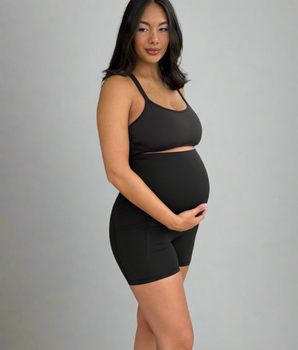
After pregnancy, two things many people worry about are a gap in their tummy muscles and changes to their pelvic floor. Both are common. Both are VERY manageable. And neither means your body is broken...
Here's what the latest research tells us, and what we recommend to our patients.
Part 1: Abdominal separation (diastasis recti)
What is it?
Your two long tummy muscles (the "six pack" muscles) are joined down the middle by a band of connective tissue called the linea alba. As your baby grows, this tissue stretches and thins to make room. That widening is called abdominal separation, or diastasis recti.
How common is it?
Very. A large Norwegian study that followed 300 first-time mums found abdominal separation in:
- about 1 in 3 at 21 weeks of pregnancy
- 60% at 6 weeks after birth
- about 45% at 6 months
- about 1 in 3 at 12 months
In other words, it's a NORMAL part of pregnancy, and for many people it narrows on its own over the first year.
How do I know if I have one?
Lie on your back with your knees bent. Place your fingers across the midline of your tummy, just above and below your belly button, then gently lift your head. You may feel a gap or a soft area. A gap wider than about 2 to 2.5cm (roughly two finger widths) is usually considered a separation.
Here's the important bit: the width of the gap isn't the whole story. What matters more is how well the tissue creates tension when you engage your deep tummy muscles. A slightly wider gap that feels firm when you engage is often more functional than a narrower one that stays soft. This is something a women's health physiotherapist or osteopath can assess with you.
Signs it might need more attention
- Doming or coning down the middle of your tummy when you sit up, lift or strain
- A soft area that doesn't firm up when you engage your core
- Feeling weak or unsupported through your trunk with everyday tasks
- A bulge that could be a hernia (see your GP to check)
What does the research say helps?
Research in this area has moved on in the last few years:
- A 2023 review found that abdominal exercises reduced the gap by less than half a centimetre on average, which isn't a meaningful difference to width alone. However, exercise still has real benefits for strength, function, confidence and wellbeing.
- A 2025 network analysis found that programs combining deep and outer tummy muscle training, especially with breathing work, performed best. The certainty of some of this evidence is still low, so more research is needed.
- You don't need to avoid crunches or planks forever. The goal is to rebuild load gradually, managing pressure well, rather than avoiding certain exercises for life.
What we recommend in practice:
- Start with breathing. Breathe into your ribs and belly, then gently draw in your lower tummy and pelvic floor as you breathe out.
- Build deep core strength with exercises such as heel slides, dead bugs and side-lying work.
- Add load gradually with bridges, modified planks, carries and rotation, watching for doming.
- Roll to your side to get out of bed in the early weeks, rather than sitting straight up.
- Get assessed by a women's health physiotherapist if you're unsure, especially before returning to heavy lifting or running.
Part 2: Pelvic organ prolapse
What is it?
Your pelvic floor muscles and connective tissues hold up your bladder, uterus and bowel. Pregnancy and birth can stretch these tissues, and sometimes one or more of these organs drops down and presses into the vaginal wall. This is called pelvic organ prolapse.
How common is it?
Continence Health Australia reports that around 1 in 2 women who have had a baby will have some degree of prolapse. Many have no symptoms at all. It's more likely after a vaginal birth, a long pushing stage or an assisted delivery, but it can happen after any birth.
Symptoms to look out for
- A feeling of heaviness, dragging or fullness in the vagina, often worse at the end of the day or after standing for a long time
- A feeling that something is coming down, or a bulge you can see or feel
- Difficulty fully emptying your bladder or bowel
- Discomfort or pain with sex
- Lower back ache that eases when you lie down
What helps?
- Pelvic floor muscle training is the first line of management, and it works best when it's tailored to you by a women's health practitioner.
- Avoid straining on the toilet. Eat plenty of fibre, drink water, and try a small footstool so your knees are higher than your hips.
- Manage heavy lifting. Breathe out on effort, keep loads close, and ask for help with heavy things where you can, especially in the early months.
- Treat a chronic cough or constipation, as both put repeated pressure on the pelvic floor.
- Pessaries are small removable devices that can support the vaginal walls. Your GP or physio/osteo can talk to you about whether one suits you.
- Be patient. Symptoms often improve over the first year as tissues recover, and hormonal changes while breastfeeding can make symptoms feel worse for a while.
Surgery is an option for some people, but most people are advised to try conservative options first, and often to wait until they have finished having children.
When to see someone
Please see your GP or a women's health practitioner if you notice heaviness, a bulge, leaking, difficulty emptying your bladder or bowel, pain with sex, or a tummy gap that isn't improving. These are common, but they're not something you just have to live with.
Feeling supported while you recover
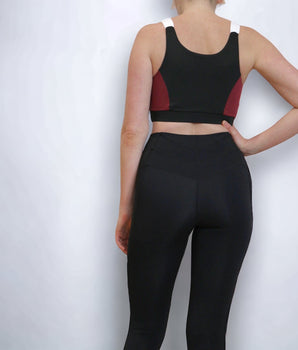
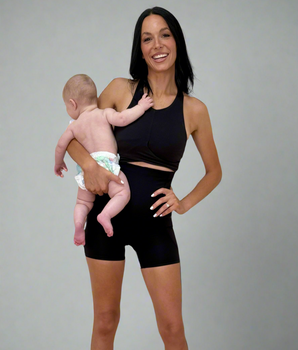
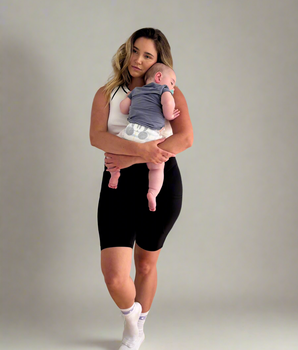
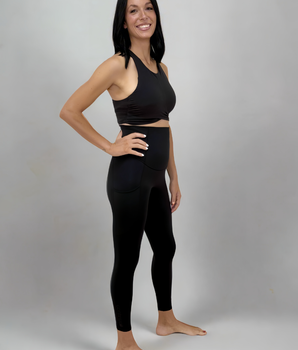
Many people find gentle compression comfortable while they rebuild strength. Our postpartum supportwear offers soft support through the tummy, hips and pelvis. It's designed to support you alongside your exercises, not to replace them. You'll find more in our compression guide and our postpartum recovery timeline.
The bottom line
Abdominal separation and prolapse are common, especially in the first year after birth. Focus on how your body functions rather than a measurement, build strength gradually, and get assessed if something doesn't feel right.
References
- Sperstad JB et al. Diastasis recti abdominis during pregnancy and 12 months after childbirth: prevalence, risk factors and report of lumbopelvic pain. British Journal of Sports Medicine (2016).
- Effects of exercise on diastasis recti abdominis: a systematic review and meta-analysis. Physiotherapy (2023).
- Network meta-analysis of interventions for postpartum diastasis recti abdominis. Scientific Reports (2025).
- Continence Health Australia. Pelvic organ prolapse.
This article is general information only and isn't a substitute for personalised advice. Please see your GP or a women's health physiotherapist for an assessment of your own abdominal wall and pelvic floor.